
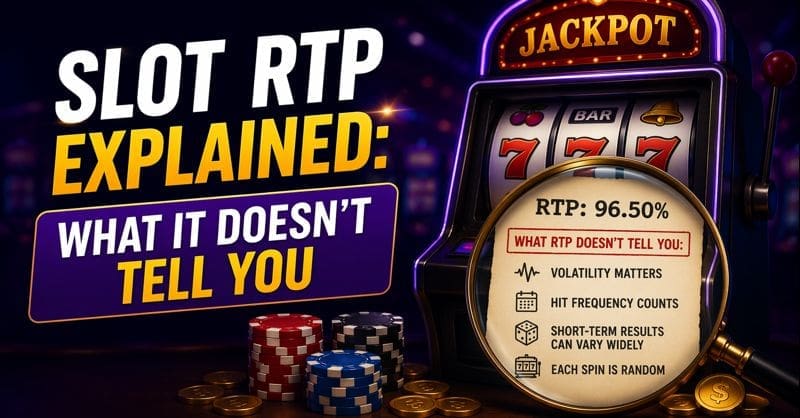
If you have spent any time around online slots, you have probably seen RTP treated like the magic number that separates a good game from a bad one. A slot with 96.5% RTP gets praised. A game at 94% gets dismissed. On paper, that sounds sensible. Higher return to player, better odds, case closed.
Real play does not work that neatly.
RTP matters, but it is one of the most misunderstood numbers in slot games. It tells you something useful, just not nearly as much as people think. If you have ever sat through a session on a “high RTP” slot and watched your balance disappear anyway, you have already learned the hard part firsthand.
The number is real, but your session is not the theory
Return to player is a long-term mathematical average. That phrase is doing almost all the heavy lifting.
When a game says it has a 96% RTP, it does not mean you will get $96 back every time you play $100. It means that across an enormous sample of spins, often in the millions, the slot payout percentage should average out to around that mark. In other words, it is about the machine’s total output over time, not your personal outcome over twenty minutes on a Tuesday night.
That disconnect trips people up constantly. I have watched players compare two games with nearly identical RTP and assume the experience will feel similar. Then one game dribbles out tiny wins every few spins, while the other stays quiet for long stretches and suddenly throws in one chunky hit. Same general return rate on paper, completely different ride.
That is where slot volatility starts to matter more than most people expect.
Volatility changes the whole feel of a slot
A high RTP slot can still be brutal in the short term if it is highly volatile. That means it may pay less often, but when it does, the wins can be much larger. A lower volatility slot usually pays more frequently, though often in smaller amounts.
This is why RTP in slots explained without any mention of variance is only half an explanation. Players do not experience averages. They experience sequences. They experience dry spells, near misses, bonus rounds, and the emotional swing of watching a balance go from comfortable to shaky in ten spins.
If you are trying to understand slot machine odds explained in a practical way, think of it like this. RTP tells you the broad math. Volatility tells you how that math tends to show up during actual play.
A game with 96.2% RTP and high volatility may be a much worse fit for a cautious player than a 95.5% game with gentler swings. That sounds backward until you remember that bankroll management matters just as much as theoretical return. The “better” game is often the one your balance can survive long enough to enjoy.
Hit frequency is hiding in plain sight
Another thing RTP does not tell you clearly is how often the game pays anything at all.
Hit frequency slots can have similar RTP figures while behaving very differently. One game may land a win on roughly one in four spins, but many of those wins are smaller than your stake. Another may hit less often but make up for it with better bonus potential or stronger base game payouts.
That matters because players often confuse activity with profitability. A busy slot that flashes lots of wins can feel generous even when it is steadily draining your balance. A quieter game can feel stingy even if it gives you a better shot at a meaningful run.
This is one reason slot payout myths never really die. People remember how a game felt more than how it actually performed. The brain loves patterns, even in RNG slot games where each spin is independent.
RTP says nothing about timing
This is probably the biggest gap between real RTP vs theoretical RTP from a player’s point of view.
RTP does not tell you when the returns happen.
It does not tell you whether the game is about to go cold for 200 spins or throw a feature in the next ten. It does not tell you whether your session will land on the ugly side of short-term variance. It definitely does not tell you a slot is “due.”
That last part is worth sitting with for a second. Random number generator slots do not build toward a payout because you have had a bad run. They do not owe you a bonus. They do not remember your previous spins. Every result is generated independently, which is why hot and cold slots myth talk tends to spread among frustrated players. It gives randomness a story.
The story feels good. The math does not support it.
Progressive jackpots skew the picture
Progressive games add another wrinkle. A progressive jackpot RTP figure may look lower than a standard video slot because part of the value is tied up in the jackpot pool. For some players, that trade-off is worth it. For others, especially those playing smaller balances, it is mostly a tax on regular play for a prize they are statistically unlikely to hit.
That does not make progressive games bad. It just means the headline number on the info screen is not enough. You need context. Are you playing for steady entertainment, bonus features, and decent hit frequency, or are you taking a shot at a long-odds top prize? Those are different goals, and the same RTP figure can mean different things depending on the game design behind it.
The house edge is simpler than the marketing
Casinos love clean numbers because players love comparing them. “This one has 97% RTP” sounds concrete. It sounds like a smart choice. But casino slot RTP strategy built around that number alone is usually too thin to be useful.
A better way to look at it is through house edge. If a game is listed at 96% RTP, the house edge is about 4% over the long run. That gives you a clearer frame. The casino still has the advantage. Your job is not to find a mythical loophole. Your job is to choose games that fit your risk tolerance, budget, and style of play.
When I talk to people who enjoy slots without getting wrecked by them, they tend to do a few things well:
- They set a session budget before they start.
- They match stake size to volatility.
- They stop chasing “due” bonuses.
- They judge games by experience, not just the payout percentage.
- They leave when the session stops being fun.
None of that is glamorous. All of it matters more than obsessing over a decimal point.
Bonus features can matter more than the top-line RTP
Modern slots are built around mechanics as much as raw percentages. Free spins, expanding wilds, cascading reels, buy features, multipliers, and bonus symbols all shape how the return is distributed. In some games, a huge chunk of RTP sits inside the bonus round. That means the base game can feel dry and underwhelming for long stretches.
This is where online slot payout rates become slippery in practice. Two games can publish similar RTP and still create completely different bankroll pressure. One may keep you afloat with frequent small returns while you wait for a feature. Another may demand patience and deeper pockets because most of the value is concentrated in rare events.
That is not always obvious from the game lobby, which is why experienced players pay attention to game behavior, not just labels.
So what should you look at besides RTP?
A smarter comparison includes more than one metric. If you are picking between games, weigh these factors together:
- RTP
- volatility
- hit frequency
- bonus structure
- jackpot contribution
That short list will tell you more about how a slot is likely to behave than RTP alone ever could.
The useful way to read the number
RTP is still worth checking. It is just not a promise, a forecast, or a shortcut to beating the game. Think of it as a broad quality signal. A very low RTP slot should raise an eyebrow. A decent one clears the first hurdle. After that, the real questions begin.
How rough are the swings? How much of the return sits in bonus features? Does the game suit your bankroll? Does it pay often enough to keep the session enjoyable? Are you playing for entertainment, for feature hunting, or for a thin shot at a huge jackpot?
Once you start asking those questions, the slot game payout system makes a lot more sense. The RTP number stops looking like a secret code and starts looking like what it really is: one useful stat in a much bigger picture.