
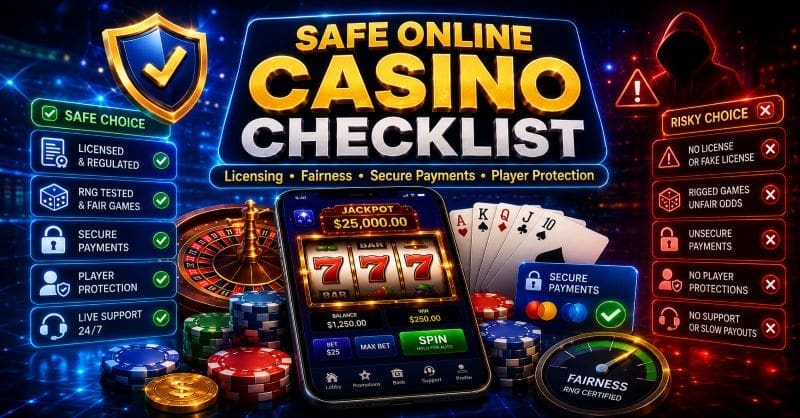
The differences between a safe and unsafe online casino — such as those concerning licensing, fairness, Secure Payments, responsible gambling, and Customer Support — rarely boil down to luck. Instead, they generally revolve around several concrete and verifiable aspects of a casino that distinguish it as either a legitimate provider or merely skilled marketers.
A Reputable online casino is not a feeling. Rather, it is a licensed gaming operator with tested software, clean payment processes, and a support staff that doesn’t simply vanish upon being asked about a delayed payout. All other features (such as the flashing welcome offers, the glossy homepages, the celebrity endorsements) are mere embellishments. By recognizing the factors listed below, identifying a Reputable and therefore safe online casino should take approximately 10 minutes.
How to verify online casino licenses
Always begin by checking if an online casino holds a valid and issued license number from a regulatory body that oversees online gaming. The license number should be displayed in the website’s footer section, and not buried in the third click of a terms page. There are only two major names you will normally see represented among safe online casinos, namely the United Kingdom Gambling Commission (“UKGC”) and the Malta Gaming Authority (“MGA”). Although both organizations have their respective nuances, the UKGC is known for being extremely strict regarding advertising regulations, affordability assessments, and how operators treat vulnerable players — which explains why websites targeting the UK audience will normally exhibit conservative promotion methods. On the other hand, the MGA regulates a large segment of Europe’s gaming markets and provides an internal dispute resolution mechanism for players who feel they have been treated unfairly by an operator.
Regulators other than the UKGC and MGA that are relevant to note include the Gibraltar Gambling Commissioner and individual state regulators (in jurisdictions such as New Jersey or Ontario), all having their own standard of compliance. Regardless of which regulating authority issues the license, it is not necessarily the authority itself that matters; rather, it is whether or not the license exists. Take the license number provided on an online casino website and enter it into the regulating agency’s public register. In my experience, i have observed online casinos cite a UKGC license number that belongs to an entirely different entity (or was revoked 18 months prior and never updated). Checking the validity of a license via a public register is a simple task that could save a player countless hours of frustration.

Importance of fairness certifications
License certification demonstrates that the online casino is permitted to conduct operations as per law. However, certifications do not demonstrate that the games offered by the casino are fair. Independent testing laboratories provide assurance regarding this aspect of the casino. To verify that an online casino utilizes certified testing laboratory services, search for names similar to eCOGRA, iTech Labs, GLI and BMM Testlabs located near seals/badges in the casino website’s footer area. Testing laboratories audit the random number generator (RNG), which generates game outcomes, and ensure that the return-to-player (RTP) percentages reported by the casino accurately reflect those specified for each game.
It is beneficial to understand RTP beyond superficially viewing it. For example, if a slot machine has a 96% RTP, it implies that over a substantial number of plays, the collective group of players will receive 96% of all amounts bet. However, RTP percentages say absolutely nothing about what occurs over a short period of time (e.g., a 1-hour session on Tuesday evening) where you may easily win 300% more than you deposited or lose your entire bankroll. What RTP percentages do inform you is whether or not the mathematical structure of the game is reliable and truthful over time, and whether or not the casino is willing to disclose this information truthfully versus concealing it. As established suppliers of high-quality games such as Evolution, Playtech and Pragmatic play post their RTP percentages on their websites along with having their games independently audited by recognized testing laboratories, this explains why you see identical game developers repeatedly associated with numerous separate online casinos.
When a casino obtains games from established developers rather than small, untested companies with no audit trail behind them, this constitutes a true sign of trustworthiness — not just a marketing checkbox.
Secure payment processing
Money represents where trust is put to its greatest test since this is where good intentions intersect with actual obstacles. A safe casino uses SSL encryption (which is indicated by https in your browser URL), which protects sensitive financial data transmitted from players’ computers to servers operated by the casino. With regard to securing sensitive financial data, SSL encryption is now considered table stakes as most regulated online casinos currently utilize it. The more significant indicator of a safe casino is how securely it stores and manages money once it enters into the casino’s accounting systems.
As stated above, Reputable online casinos maintain segregated player funds, i.e., deposits received from players are maintained separately from operational monies used by the casino. This distinction is important to recognize as it directly affects the manner in which your deposits are processed. Specifically, segregated player funds protect players from losing their deposits in case the casino becomes insolvent. Unfortunately, this is not merely theoretical; instances exist where operators went bankrupt and players discovered that their deposits were commingled with operational funds.
Another critical factor in determining whether or not an online casino is safe is its history in processing payouts. Players expect that their withdrawals will occur quickly. Withdrawals processed via ewallets (e.g., Skrill/neteller/PayPal), when available at Reputable online casinos, normally occur within 1 day. Withdrawals made via credit/debit cards normally occur within 2-5 business days throughout the industry due to banking procedures — not due to slow service by the casino. Players want to observe consistent practices between what is stated in a withdrawal policy and what actually occurs. If the terms claim that withdrawals are processed within 24 hours but a player waits 6 days for payment with no rationale given for the delay, this represents a serious problem — not an unfortunate circumstance.
Players expect their account verification (KYC) process to be completed once (early and completely) so that they can proceed immediately to make withdrawals or continue playing without interruption. Casinos that request multiple forms of identification only after a player makes a large withdrawal are using verification as a stalling tactic — one of the clearest red flags indicating an unreliable casino exists.
Indicators of strong player protections
An online casino that only cares about taking your money and does not care about your welfare will not be referred to as trustworthy regardless of how fast your withdrawals are processed. Reputable online casinos will provide accessible and user-friendly responsible gaming tools (as opposed to burying them in difficult-to-access areas of their website). Therefore, responsible gaming tools should be capable of being accessed and applied instantly by players (i.e., setting deposit limits in two clicks, displaying reality checks during extended gameplay sessions to advise players of time elapsed since beginning gameplay etc.), enabling players to self-exclude from accessing their accounts temporarily or permanently (and excluding players from access to their account instead of sending a weak reminder to reconsider).
Age verification should also be mentioned as age verification constitutes one of the strongest indicators of a serious operator. Websites that permit players to complete registration without authenticating player identity represent shortcuts taken by operators intended to circumvent mandates from regulators requiring identification verification for regulatory purposes. As most regulated online casinos also link to independent support organizations (GamCare.org.uk/GambleAware.co.uk) that provide confidential assistance free of charge and completely independent of the casino’s interest(s), this action represents more than simply meeting regulatory obligations; this action represents acknowledgment that gaming presents risk(s) and therefore player protection will persist longer than any single gaming session.
Identifying safe customer service & Reputation
Customer service is evaluated prior to making serious deposits by me and I would suggest you consider evaluating customer service similarly. Ask a somewhat unusual question (regarding withdrawal timing or a specific promotion), see how quickly an agent responds with answers. Quick responses with correct answers in less than a few minutes via live chat constitute greater evidence than any five-star review. Indecipherable copied-and-pasted responses, or agents who are only reachable via email with 48-hour response times indicate poor investment in customer service — particularly after errors arise.
Reviews from other players are useful however should be viewed with skepticism. Reviews published concurrently with the launch of a new online casino probably signify minimal value. Evidence of a casino’s behavior towards negative reviews/complaints on independent forums (not testimonial sections curate by the casino) may be more indicative of a casino’s overall Reputation. Responsive complaint management appears to resemble acknowledgement of error/publicly stating the cause of error/explaining solution/actions taken/follow-through-even-if unfavorable explanations were rendered. Casinos ignoring complaints altogether/or responding solely using generic corporate language normally indicate a trend-not-an-isolated incident. Regulatory dispute resolution agencies affiliated with authorities such as UKGC/MGA exist exclusively for circumstances where an operator refuses to resolve disputes through agreed-upon channels — and thus a credible online casino will never intentionally engage in protracted litigation with its customers.
Common red flags identifying unsafe online casinos
Once sufficient numbers of reviews have been compiled — as well as after observing trends repeatedly emerge through various reviews — common warning Signs appear through predictable patterns. A few items emerged frequently enough for me to check explicitly before depositing money:
No license number visible; or an identifiable license number does not correspond to the casino name when verified against the regulator’s public registry;
Bonus terms buried in verbose language with excessive wagering requirements (above 50x); or withdrawal limits imposed on wins obtained previously not previously disclosed;
Verification requests only submitted after requesting withdrawal; especially after obtaining a big win;
Independent testing lab logos (such as ecogra/iTech Labs/GLI/bmm testlab) do not appear anywhere on the website; or any references to testing labs appear only on pages related to marketing;
Unreachable Customer Support outside limited hours; or support ceases communication once a complaint becomes specific. While none of these individually equates to automatic doom, a regional casino may have legitimate reasons for providing limited hours for Customer Support; however, when two or three of these warning Signs appear simultaneously — this signifies more than coincidence; this indicates a developing pattern exhibited in virtually all complaint threads I’ve reviewed relative to scam casinos